


Militant Islam Monitor > Articles > Ashrafuzzaman Khan:Convicted Death Squad Killer Enjoys Celebrity Status Among Muslims In US & Lead ICNA In NY For Years
Ashrafuzzaman Khan:Convicted Death Squad Killer Enjoys Celebrity Status Among Muslims In US & Lead ICNA In NY For Years
Khan Headed The Islamic Circle Of North America In NY (ICNA) & Is A Member Of The North American Imams Foundation / Federation (NAIF)
November 19, 2026
Convicted Death Squad Leader Ashrafuzzaman Khan Sighting in Texas
Will the U.S. pursue justice for Khan's victims, or will it continue to serve as his safe haven?
November 6, 2026 by Joe Kaufman 1 Comment
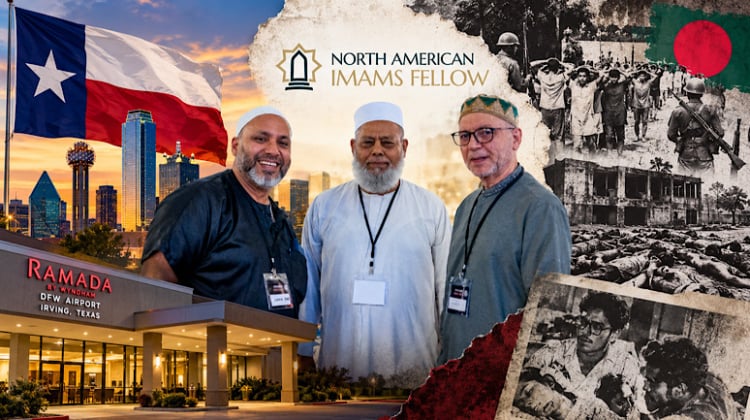
A photograph appearing on the website of the North American Imams Fellowship (NAIF) may provide the most recent publicly known image of Ashrafuz Zaman Khan (Ashrafuzzaman Khan), a Muslim cleric who was sentenced to death in Bangladesh for his role in the brutal execution of 18 intellectuals as a leader of the Al-Badr terrorist militia during the country's 1971 War of Independence.
The photograph, identified by this author, appears to show Khan attending NAIF's 2024 annual conference, held at the Ramada by Wyndham DFW Airport in Irving, Texas. The image was subsequently used to promote NAIF's 2026 conference and currently occupies a prominent position atop the organization's online photo gallery.
Khan's connection to NAIF is hardly incidental. He previously served as President of the organization's Executive Committee, when it operated under the name North American Imams Federation.
Among the featured speakers at the 2024 conference was Nihad Awad, national Executive Director of the Council on American-Islamic Relations (CAIR). Awad drew widespread condemnation after publicly expressing joy over the October 7 Hamas massacre of Israeli civilians.
The group that sponsored the event was Islamic Relief, an entity that has been banned in a number of countries. Israel has called it a front for Hamas. The UAE has placed it on its terrorist list. Banks in England have dropped the group's accounts.
NAIF has also expressed admiration for controversial Islamist figures. In September 2022, the organization mourned the death of Yusuf al-Qaradawi, the longtime spiritual leader of the Muslim Brotherhood and a supporter of suicide bombings.
Khan's history is just as troubling, if not more so.
On November 3, 2013, Bangladesh's International Crimes Tribunal sentenced Khan to death in absentia after finding him guilty of involvement in the abduction, torture and murder of 18 people during the final days of the 1971 Bangladesh Liberation War. His co-defendant, Chowdhury Mueen Uddin, received the same sentence.
It should be noted that nearly 90% of Bangladesh's populationwas Muslim at the time of the sentencing, so there could be no claim of anti-Muslim bias in this case.
The victims included nine university professors, six journalists, and three physicians. They were among the intellectuals systematically targeted as Pakistani forces and their Islamist collaborators sought to crush Bangladesh's independence movement.
During that conflict, prosecutors identified Khan as a commander within al-Badr, a paramilitary death squad associated with Jamaat-e-Islami, the South Asian Islamist movement that opposed Bangladesh's separation from Pakistan.
Al-Badr continues to operate out of Pakistan and has been linked to numerous attacks against civilians in Kashmir, including deadly violence against members of the Hindu Kashmiri Pandit minority.
The human toll of the 1971 war was staggering, with upwards of three million people said to be killed.
One particularly chilling piece of evidence presented during Khan's proceedings concerned a diary reportedly recovered from a room he had occupied following the war. According to testimony before the tribunal, the diary contained the names of several persons targeted for assassination.
Despite his conviction, Khan has continued living in the United States as a high-profile Muslim cleric rather than facing the sentence imposed by Bangladesh.
And it does not appear that the Muslim community has been fazed by the sentencing or allegations, as Khan's connections to U.S. Islamic organizations extend beyond NAIF.
According to his LinkedIn page, Khan currently serves as an imam associated with the Islamic Circle of North America(ICNA) and has remained in this capacity for well over three decades. He previously held prominent leadership positions within ICNA, including national Vice President and President of its New York division.
Since its founding, ICNA has maintained affiliations with and/or provided financial support to South Asian extremist organizations linked to terrorism. These include the Al-KhidmatFoundation (AKF), a Hamas financier with which ICNA continues to partner; Falah-e-Insaniat Foundation (FIF), which the U.S. government has labeled a front for Lashkar-e-Taiba (LeT), the group responsible for the 2008 Mumbai attacks; and the Milli Muslim League (MML), the political arm of LeT.
For decades, this author has called upon American authorities to address Khan's presence in the United States. Working with others, including Bangladeshi expatriates seeking accountability for the atrocities of 1971, I have repeatedly raised the question of why a man convicted of such horrific crimes has remained beyond the reach of Bangladeshi justice.
The photograph from Irving adds renewed urgency to that question.
How can an individual sentenced to death for participating in the murders of professors, journalists and doctors appear at an American religious conference – along with documented terror supporters – without prompting greater scrutiny from federal authorities?
Why has the United States insisted on allowing Khan to remain shielded within its borders?
And why have organizations maintaining relationships with Khan not been subjected to a thorough federal examination of those relationships?
For the families of the 18 murdered intellectuals, the passage of more than half a century has not erased their loss.
Ashrafuzzaman Khan's apparent appearance at a Texas conference should serve as a reminder that the pursuit of justice for the atrocities of 1971 remains unfinished.
Beila Rabinowitz, Director of Militant Islam Monitor, contributed to this report.
https://www.frontpagemag.com/convicted-death-squad-leader-ashrafuzzaman-khan-sighting-in-texas/
#######
AI Overview
Ashrafuzzaman Khan (also spelled Ashrafuz Zaman Khan; born February 28, 1948) is a Pakistani-born cleric and former leader within the Islamic Circle of North America (ICNA) who was convicted in absentia by Bangladesh's International Crimes Tribunal for war crimes committed during the 1971 Bangladesh Liberation War. [1]
Background & Role in 1971
- Early Life: Born on February 28, 1948, in Faridpur, East Bengal (then part of Pakistan). [1]
- 1971 War: During the 1971 war, he served on the Central Committee of Islami Chhatra Sangha (the student wing of Jamaat-e-Islami) and held a leadership/commander role in the Al-Badr paramilitary force. [1, 2]
- Post-1971 Migration: After the war and the independence of Bangladesh, Khan moved to Pakistan and worked for Radio Pakistan before immigrating to the United States. [1]
Connection to ICNA & U.S. Activities
- After settling in the U.S., Khan became involved in South Asian Muslim community organizations in New York, including heading the Queens, New York branch of the Islamic Circle of North America (ICNA)and serving as president of the Imams of America association. (Some reports have also described him as holding other senior roles or past leadership positions with ICNA.) [1, 2, 3]
- In 2009, reports indicated that the U.S. Department of Justice investigated whether Khan failed to disclose past organizational affiliations during his U.S. naturalization process, and U.S. officials requested files from Bangladesh related to 1971. [1]
War Crimes Conviction
- On April 25, 2013, Bangladesh's International Crimes Tribunal brought formal charges against Khan as a key executor/commander of Al-Badr and issued an arrest warrant. [1, 2]
- On November 3, 2013, the tribunal sentenced him to death in absentia for torture and murder connected to the killings of 18 Bengali intellectuals—including university professors, journalists, and doctors—in December 1971. [1]
######
An online archive of chronology of events, documentations, audio, video, images, media reports and eyewitness accounts of the 1971 Genocide in Bangladesh in the hands of Pakistan army.
The Travail of Ashrafuzzaman Khan's Infamous Diary
NEWS FROM BANGLADESH, NOV 10, 99
By Jamal Hasan
Who's Ashrafuzzaman Khan? Why is it so important that we now know the content of his dairy? Please be patient and read this write-up. I will let you draw your own conclusion regarding the culpability of this man.
It was the first week of December of 1971 — it was also the final chapter in our nine month long days of fire and blood. Forces under the joint command of our valiant Mukti Bahini and the Indian army had almost encircled Dacca from all directions. But even as all seemed lost for the beleaguered Pakistani armed forces, sinister forces were at work at the Governor's House determined more than ever to deliver the coup de grâce to the "upstarts" who had refused to accept the fate of a subject race. General Niazi was huddling with his comrade the infamous Major General Rao Farman Ali, and their chief troubleshooter, Major Siddique Salek. They had just received the list they had been expecting from Al-Badr and Al-Shams. Ashrafuzzaman Khan, a commander of the brutal Al-Badr, had just compiled a list of Bengali intellectuals for the "benefit" of the high command in the Governor's House. It was the list of intellectuals who have been targeted for elimination. The plan was to kill them immediately so that if Bangladesh becomes an independent nation, it will have to make do without those that can contribute significantly to rebuild the infrastructure of the devastated nation. It would be Pakistan's parting kick to Bangladesh, so to speak.
Many of the Bengali intellectuals listed by Ashrafuzzaman Khan were taken out of their homes in the dead of night in that eventful week of December in 1971. Needless to say, none of them lived to see the light of day. Even in the moment of their defeat, Generals Niazi and Ali must have relished the thought that they have forced Bangladesh to pay an extremely heavy price for its independence. It must have given them no little pleasure to imagine that Bangladesh will fall apart in no time without the services of so many of its leading intellectuals.
Bangladesh was liberated on December 16, 1971. Unfortunately, it took longer than it should have taken for the new administration to attend to its tasks. By the time the investigators arrived at the residence of Ashrafuzzaman Khan, he had fled. However, in haste, he had left behind a crucial piece of evidence. The investigators rummaging through his leftover items managed to recover that piece of the puzzle from his house. They found Ashrafuzzaman Khan's diary. In it was that infamous list of intellectuals in his own handwriting. It was indeed a gruesome find that shocked the people. Ashrafuzzaman Khan was a wanted man. Photos of the suspect were posted in all Bangladeshi newspapers. People were urged to apprehend the criminal. But all this was too late. Ashrafuzzaman had managed to flee not just his residence, but his country as well by the time the search was on for his arrest.
Today, Ashrafuzzaman Khan leads an active life of all places in New York. He has assumed a role of leadership in the Islamic movement in the city. Ashrafuzzaman Khan is now the President of the Islamic Circle of North America. I was reminded anew of his terrible past as I read a recent issue of the Washington Post (November 1, 1999). It carried a statement by Ashrafuzzaman Khan on the tragic Egypt air accident. Ashrafuzzaman Khan was quoted as saying, "Sometimes, we face that we are helpless…. another man lost his parents. Nobody knows anything. Everybody is sad. But we have to put our faith in God." This is coming from the man whose infamous list had left so many children without their fathers in that fateful week in December of 1971. What an irony it is that this conspirator par excellence of Bangalee intellectual killings in 1971, is now a dyed-in-the-wool humanist, after all these years! But, is he a humanist? No. He is just a wolf in sheep's skin. That is what he is!
We, Bangladeshis, seem to be singularly devoid of self-esteem. Bangladesh had failed miserably to bring the war criminals to justice after the surrender of Generals Niazi and Ali on 16th December 1971. And today, Sheikh Hasina seems to be more interested in pursuing only those that had killed her kith and kin on 15th August 1975. No one seems interested to bring the killers of 1971 to justice. To me, this is the greatest travesty of justice in Bangladesh.
Of course, Ashrafuzzman Khan hasn't quite been allowed to forget his criminal past. A few years ago, Shahriar Kabir, a leader of Ghatok Dalal Nirmul (Efface the killers and conspirators) Committee exposed the whereabouts of Ashrafuzzaman Khan who, needless to say, stoutly denies any wrongdoing. But editions of the directory of collaborators, "Ekatturer Ghatok Dalal Kay Kothai" (Where are the killers and conspirators of 1971?") continues to carry Ashrafuzzaman Khan's photo together with a print of the pages of his infamous diary.
The Nirmul (Efface) Committee has branches in almost all States of USA. Most of the members were very active under the leadership of Shaheed Janani Jahanara Imam. They had even sent a lawyer to assist the prosecution during the epoch making People's Trial of Prof. Golam Azam and his cohorts. When will they go after Ashrafuzzaman Khan? In America, it shouldn't be too difficult to force a war criminal to answer in a court of law. The million-dollar question is — who will bell the cat?
Jamal Hasan writes from Washington, DC. His email address is: [email protected]
"Genocide'71 – an account of the killers and collaborators", Published in Dhaka, Page 189: Segment where Ashrafuzzaman Khan (now in New York, and head of Queens branch of ICNA) is cited.
Similarly, Saudi Arabia is serving as a sanctuary for some of the leading Al-Badrs (leaders of death squads in 1971). Here we would like to give the example of Ashrafuzzaman Khan, one of the Al-Badr high command. Ashrafuzzaman Khan, was one of the chief Al-Badr executioners. It has been clearly proved that he himself shot to death 7 teachers of the Dhaka University in the killing fields at Mirpur. A certain Mofizzuddin, who drove the vehicle which took these helpless victims of Ashrafuzzaman to Mirpur, has clearly identified Ashrafuzzaman as the "chief executer" of the intellectuals.
After Liberation, Ashrafuzzaman's personal diary was recovered from 350 Nakhal Para where he resided. On two pages of the diary, the names of 19 teachers of the University have been entered, as well as their addresses in the University quarters. The name of the Dhaka University Medical Officer, Mohammad Murtaza, has also been noted down in this diary. Of these 20 persons, eight were missing on December 14: Munier Chowdhury (Bengali), Dr. Abul Khair (History), Ghiasuddin Ahmed (History), Rashidul Hasan (English), Dr. Faizul Mohi (I. E. R) Dr. Munaza (Medical Officer).
From the confession of Mofizuddin, it has been learned that Ashrafuzzaman shot these people with his own hands. As a result of Mofizuddin's confession, the decomposed bodies of these unfortunate teachers were recovered from the marshes of Rayer Bazar and the mass grave at Shiyal Bari at Mirpur. There were other names in the diary including the following: Dr. Wakil Ahmed (Bengali), Dr. Nilima Ibrahim (Bengali), Dr. Latif (I. E. R), Dr. Maniruzzaman (Geography), K. M. Saaduddin (Sociology), A. M. M. Shahidullah (Mathematics), Dr. Sirajul Islam (Islamic History), Dr. Akhtar Ahmed (Education), Zahirul Huq (Psychology), Ahsanul Huq (English), Serajul Islam Chowdbury (English), and Kabir Chowdhury.
On another page of the diary there were the names of 16 collaborating teachers of the University. Apart from these there were also the names of Chowdbury Moinuddin, the man in charge of the operation to kill intellectuals, Showkat Imran, a member of the central Al-Badr command, and the head of the Dhaka Badr forces.
Apart from the names of the slain intellectuals, the diary also contained the names and addresses of several other Bengalis. All of them lost their lives at the hands of the Al-Badr. On a small piece of paper the name of the Member Finance of the Pakistan Jute Board, Abdul Khaleq, had been written down, along with the name of his father, his Dhaka address, as well as his permanent address. On December 9, 1971, the Al-Badr took away Abdul Khaleq from his office. They demanded Taka 10,000 as ransom. The Al-Badr then went to Abdul Khaleq's house carrying a letter from him in which he asked that the money be paid to his kidnappers. Abdul Khaleq's wife was unable to give more than Taka 450 at the time. She promised that she would give them the rest of the money later, and pleaded with them to return her husband. But Abdul Khaleq never came back.
Ashrafuzzaman has also been implicated in the murder of some journalists. It was Ashrafuzzaman who kidnapped the shift-in- charge of the Purbodesh, and the Literary Editor, A. N. M. Gholam Mustafa.
Ashrafuzzaman Khan, was a member of the Central Committee of the Islami Chhatra Sangha. After liberation he went to Pakistan. At present he is employed in Radio Pakistan.
Update: Since publication of this book, Ashrafuzzaman Khan has moved to New York and now heads the Queens branch of ICNA (Islamic Circle of North America)
Source: Shobak.org
https://www.genocidebangladesh.org/the-travail-of-ashrafuzzaman-khans-infamous-diary/
#######
Bangladesh War Crimes Trial Proceeds Without ICNA Official
IPT News
July 24, 2013
 In the United States, Ashrafuzzaman Khan ostensibly is a respected Muslim cleric, president of the Imams of Americaassociation and past secretary general of the Islamic Circle of North America (ICNA).
In Bangladesh, a court is hearing evidence alleging that Khan is a war criminal, someone who helped draft a list of intellectuals who would later be kidnapped and killed in the final days of the 1971 war of liberation against Pakistan.
Khan, 65, is being tried in absentia. Bangladesh's International Crimes Tribunal ruled last month that "there are sufficient and substantial materials" to warrant proceeding to trial against him on 11 war crimes counts.
He remains on the executive board of ICNA's New York chapter and has not commented publicly on the allegations. He is being tried along with Chowdhury Mueen-Uddin, a prominent imam in the United Kingdom who helped create the Muslim Council of Britain.
The two are accused of leading a killing squad called Al-Badar, which was an offshoot of the Islamist group Jamaat-e-Islami. The Islamists supported Pakistan during the war. As many as 3 million people died in battle for independence and millions more sought refuge in neighboring India. In its final days in December 1971, dozens of intellectuals – journalists, doctors, professors and others – were systematically rounded up. They were taken from their homes at gunpoint and later found in a mass grave. In some cases, the charging papers say, the bodies were never recovered.
"Al-Badar acted as 'killing squad', in furtherance of plan and policy of Pakistani occupation army," the Tribunal's prosecution wrote. Khan was the "'chief executor' of Al-Badar to the accomplishment of the barbaric crimes, in furtherance of common plan and design, with intent to paralyze the Bengali nation."
Britain's Channel 4 broadcast a documentary on Bangladesh's war of independence and the resulting atrocities which can be seen here.
Khan allegedly was on a central committee for the Jamaat-e-Islami's student wing, called Islami Chatra Sangha. The names of many victims were found in a diary found in Khan's home after he fled the country.
Khan's court-appointed attorney denies the charges, saying the Pakistani army was responsible for the killings and that Khan was never in Al-Badar.
So far, three witnesses have placed Khan at the scene of abductions:
1. Masuda Banu Ratna – whose uncle Giasuddin Ahmed was taken at gunpoint from Dhaka University – said she knew Khan and Mueen-Uddin from student political activities and recognized them when they came for her uncle. His body was found three weeks later, dumped in a mass grave.
2. Enamul Huq Khan testified that his father, a history professor, was taken from their home by a handful of men at gunpoint. He said he later was told by a man who was driving the Al-Badar squad around that Khan pulled the trigger and killed his father. He didn't know Khan at the time, but said he recognized him the following year when a newspaper published pictures of Khan and Mueen-Uddin with a caption "help to capture the killers."
3. The son of slain journalist Selina Parvin said Mueen-Uddin and Khan were among those who took her away from their home on Dec. 13, 1971.
The Tribunal has faced some criticism, and its rulings sparked violent protests led by Jamaat-e-Islami. More than 80 people died after the Tribunal sentenced Jamaat leader Delwar Hossain Sayeedi to death in March.
Talk of Khan being charged has circulated for years. A report also indicated that the Justice Department's Office of Special Investigations was investigating Khan to determine if he failed to mention his activities when he applied for U.S. residency and naturalization.
ICNA, the organization he led, was founded by South Asian Muslims. Its constitution draws heavily from the Jamaat-e-Islami and its curriculum emphasizes writings by Jamaat founder Syed Abul Ala Maududi. Maududi advocated that Muslims "must strive to change the wrong basis of government, and seize all powers to rule and make laws from those who do not fear God."
Khan offered a similar sentiment in greeting people to ICNA's 1999 convention. Muslims, he wrote in the convention program, "have a culture and civilization which once ruled the world and still has the viability to rule the world again."
Khan has not publicly addressed the charges against him and ICNA has not commented since last month's charges were accepted. In a March statement, it dismissed the tribunal's existence as a purely political effort "to silence opposition figures" and said its actions amount to human rights violations. Mueen-Uddin has posted a statement denying all the charges against him and ridiculing the Tribunal.
It is unclear what happens if Khan is convicted. The United States has no extradition treaty with Bangladesh, and U.S. Ambassador for Global Justice Stephen J. Rapp has been among those taking issue with some of the Tribunal's standards. If the United States is satisfied with the evidence, or even if it can be proven that Khan was a part of Al-Badar and failed to disclose that fact on immigration papers, his interaction with the courts may be just beginning.
https://www.investigativeproject.org/4098/bangladesh-war-crimes-trial-proceeds-without-icna
#####
NORTH AMERICAN IMAMS FEDERATION
ABOUT
The mosques and Islamic organizations in the U.S. and Canada serve millions of Muslims. As an Imam provides an individual ministry of purpose, presence, and peace, NAIF aims to replicate that sacred care to the Imam as an individual. This is a collegial peer-to-peer network of advice and support. Through the support of the spiritual care leader, NAIF also aims to provide a united Muslim voice via a consensus from its Imam members.
A Practical Resource for a Fraternity of Imams
The aim of this clerical consortium is simple: to help meet the tangible and spiritual needs of Imams in the U.S. and Canada. As an anchor umbrella group, NAIF seeks to facilitate cooperation, coordination, and fellowship between the leaders of mosques and Islamic Centers in the U.S. and Canada. NAIF also strives to realize its sacred mission to Imams through periodical conferences, training programs, conventions, and publications. NAIF has established four regional offices in the U.S. and plans to continues its expansion to better coordinate and facilitate within communities the steps necessary for an effective achievement of its goals in North America. NAIF also aims to help Imams enhance avenues to better his relationship with the masjid leaders and administrators as well as the mosque congregation on a whole.
Members connect at the annual NAIF conference and throughout the year in cyberspace to pray with and for one another, to share Qur'anic teachings, to share resources, and to discuss questions about the sacred work of the clergy, and the many challenges facing people, communities, and the world.
NAIF is committed to, and focuses at, supporting Imams in their sacred mission. The loftiest of this mission is calling people to the ways of Allah and encouraging them to observe the Islamic acts of worship.
A Symbiotic Approach
NAIF establishes relationships with Imams of mosques and Islamic Centers that are licensed to operate in the United States and Canada as a non-profit organization. NAIF's relationships are collaborative, complementary, and cooperative. They are based on interests and common goals. NAIF will collaborate with Islamic organizations to help achieve common goals, complement their efforts to better serve Islam, and cooperate with them in that which is rewarding in Islam including providing a united theological response to the growing and troubling tide of Islamophobia in the West.
NAIF: A History Grounded in Need
NAIF is committed to helping the Imam in his sacred mission. It was founded in October 2002 and formally incorporated two years later to pioneer a new era of collegial support and to serve as a representative voice for the Islamic clergy profession. The impetus for the founding was the lack of a professional body in North America that is concerned specifically with the welfare of Imams. Existing Islamic organizations provided limited or no support to Imams and often had secondary or tertiary goals that were sometimes a departure and often inconsistent from the best interest of the Imam. This left the aspirations, visions, and goals of Imams partially unattended. From this scarcity, a group of Imams took it upon themselves to bridge that gap.
NAIF was incorporated as an organization founded, empowered, and administered solely by Imams. The charter states that the interests, goals, visions, and aspirations of the organization would, in kind, be derived from, and formulated by Imams. Within this from us by us mentality, NAIF believes that it best supports the ethos and justification for an organization particularly concerned with the Imam's welfare and prosperity.
https://imamsofamerica.weebly.com/about-naif.html
 Printer-friendly version
 Email this item to a friend